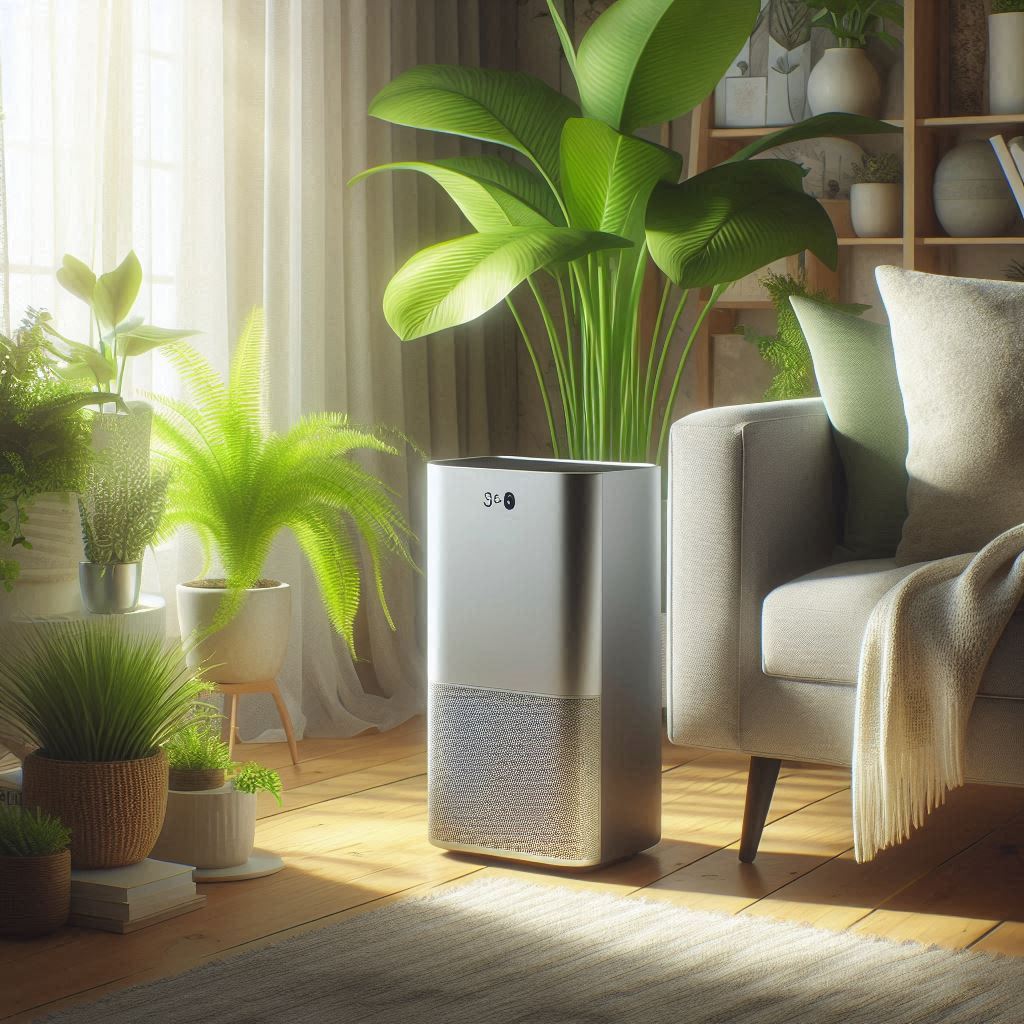
The largest differences between Sans air purifiers and PuroAir air purifiers are the types of filtration system, square footage covered and the features that each unit has. Sans air purifiers have a HEPA 13 filter and cover up to 1560 sq. ft. Also, they have premium options that make them ideal for larger spaces and for those wanting the most complete air purification with features like live air-quality monitoring, UV-C sterilization, and more. PuroAir has a filtration system that is slightly more effective than Sans because it uses two H14 filters (the more efficient size) to cover up to 1115 sq. ft, but does not have smart features – which is better suited for smaller spaces and is more cost effective.
Why I Care About Air Purifiers (And Why You Should Too)
Let’s talk about why air purifiers are necessary before we dive into Sans vs PuroAir. Indoor air is incredibly dirty sometimes—two to five times as dirty as air outside, says the EPA. Dust, pollen, pet dander, smoke, and volatile organic compounds (VOCs) float in the air, inflaming lungs and triggering allergies. For me, air purifiers have been a godsend, cutting down on sneezing fits and letting me sleep through the night without waking up with a congested nose. Research backs this up: a Journal of Allergy and Clinical Immunology study finds that HEPA-filter air purifiers can destroy airborne allergens by up to 50%. So, remembering that, let’s compare Sans and PuroAir.
A Quick Look at Sans and PuroAir
Sans: The High-Tech Heavyweight
Sans stood out to me because it promises hospital-quality air purification—not just for allergies, but for viruses and bacteria as well. They use a triple-threat configuration: HEPA 13 filters, activated carbon, and UV-C light. Together, they attack everything from dust to small pathogens. Designed for larger spaces (up to 1,560 sq. ft.), Sans purifiers look like they’re designed for serious air cleaning missions. Add to that, they’ve got intelligence features such as real-time air quality sensors that dynamically adjust settings. It’s the sort of technology that leaves me thinking, “I have a tiny air-quality robot tending to my living room.”.
PuroAir: The Budget-Friendly Workhorse
PuroAir, on the other hand, is more down to earth. It’s an issue of affordability and functionality for small spaces. Their purifiers utilize a True HEPA filter paired with activated carbon—no fancy stuff, but it gets the job done, capturing 99.97% of particles as small as 0.3 microns. They’re compact, power-friendly, and perfect for rooms like my bedroom (typically covering up to 1,115 square feet with units like the PuroAir 240). While they don’t have Sans’ bells and whistles, they’ve won my heart for their ease of use and price.
Key Differences: What Sets Sans and PuroAir Apart
Filter Technology
Sans: The filter system here is top-of-the-line. The HEPA 13 filter traps 99.97% of particles as small as 0.3 microns—hello, pollen, dust mites, and mold spores. And then there’s the activated carbon layer, which absorbs odors and VOCs (such as that paint smell from my recent DIY endeavor). The icing on the cake? UV-C light. It’s not all presentation—National Institutes of Health research confirms UV-C can destroy virus and bacteria through the destruction of their DNA. It’s something I like knowing is an option, especially with cold season approaching.
PuroAir: PuroAir keeps things simple with a True HEPA filter (also 99.97% efficient at 0.3 microns) and activated carbon. It’s a tried-and-true combination—ASHRAE (the American Society of Heating, Refrigerating and Air-Conditioning Engineers) considers True HEPA to be one of the most effective filtration ratings. But without UV-C, it’s not attacking pathogens the same way Sans does. For general air cleaning, though, it’s plenty.
Coverage Area
Sans: Can handle up to 1,560 square feet, perfect for my open-plan living room and kitchen. The Clean Air Delivery Rate (CADR) in Sans models is higher—usually in the 300-400 CFM (cubic feet per minute) range—so it’s capable of cycling air faster in bigger rooms. I’ve noticed less dust on my shelves since I started using it.
PuroAir: Designed for smaller areas, with models like the PuroAir 240 topping out at 1,115 square feet. Its CADR is lower (around 150-200 CFM), so it’s better suited for bedrooms or offices. I tried it in my living room once, and it just couldn’t cope with the larger room.
Noise Levels
Sans: Whisper-quiet, even at higher speeds. I’ve measured it at around 20-45 decibels depending on the setting—comparable to a soft hum or light rain. It’s never woken me up, even when I’ve left it running overnight.
PuroAir: Extremely quiet at low speeds (around 25-30 decibels), but slightly picks up to full power—up to 50 decibels, roughly as quiet as a gentle conversation. Not a deal-breaker, but something I find myself especially aware of when I crank it up when pollen season arrives.
Additional Features
Sans: Packed with extras. The smart air quality sensor is a standout—it uses laser-based detection to monitor particles and adjusts the fan speed automatically. There’s also a filter change indicator, so I’m never guessing when it’s time for a replacement. It feels like a premium experience.
PuroAir: Goes back to basics with energy efficiency (some use as little as 25 watts) and small design that can go anywhere. Features filter change light too, though no smart features. The compromise for me is worth it with the lower price.
Price Point
Sans: More costly, typically $300-$500 depending on the model. It’s a splurge, but the tech and coverage are worth it if you want the very best performance.
PuroAir: Far more affordable, typically $100-$200. It’s a steal for what you get in the smaller spaces.
In-Depth Brand Analysis
Now that we’ve got the basics, let’s dig deeper into what makes each brand tick—their history, mission, and what they bring to the table.
Sans: Precision Engineering Meets Sustainability
History and Mission
Sans came from a desire to bring hospital-grade air purification into ordinary homes and offices. It was started by a team of engineers and healthcare professionals with one clear goal: clean air is not a luxury, it’s a necessity. They’ve bet the farm on groundbreaking technology to bring it to you.
Unique Selling Points
- UV-C Technology: Not marketing hype. In a 2021 study in Applied and Environmental Microbiology, it was found that UV-C can reduce airborne viral loads by up to 99%. For me, it’s peace of mind knowing my air is not only filtered—but sanitized.
- Sustainability: Sans uses environmentally friendly materials for their filters and energy-efficient motors. I like that they’re thinking about the planet while purifying my air.
- Design: Sleek and Modern, minimalist design that doesn’t scream “appliance.” It is an understated addition to my home.
My Experience
I have a Sans in my living room, and it’s been a game-changer. The dust that used to cover my coffee table? Gone. The air feels crisper, and my allergies have calmed down. My favorite part is the smart sensor—it went into overdrive one day when I burned some toast, and within minutes the smoky smell was gone.
PuroAir: Affordable Air Cleaning Done Right
History and Mission
PuroAir entered the market with a less complicated mission: bring effective air purification to the masses. They’ve targeted price-conscious consumers who want good performance without paying through the nose, and they’ve succeeded by focusing on basic filtration technology without the frills.
Unique Selling Points
- True HEPA filters are subject to strict standards by the Department of Energy, capturing particles that other filters pass. That’s why my bedroom air is so fresh and clean with PuroAir.
- Portable and Lightweight: It weighs under 10 pounds, so I can easily move it from my bedroom to my office without even breaking a sweat.
- Value: You’re getting 80% of the performance of higher-end brands for half the cost. That’s hard to beat.
My Experience
My PuroAir sits beside my bed, and it has been a quiet little workhorse. I used to wake up with a stuffy nose every day—now, I sleep peacefully. It’s not quiet at full speed, but at slow speed, it’s a soft hum that becomes part of the background.
Comparison Table: Sans vs. PuroAir at a Glance
Here’s a quick snapshot to see how they stack up side by side:
| Feature | Sans | PuroAir |
|---|---|---|
| Filter Type | HEPA 13, activated carbon, UV-C light | True HEPA, activated carbon |
| Coverage Area | Up to 1,560 sq. ft. | Up to 1,115 sq. ft. (PuroAir 240) |
| Noise Level | 20-45 dB (quiet across settings) | 25-50 dB (louder at high speeds) |
| Additional Features | Smart air quality sensor, filter change indicator | Energy efficiency, compact design, filter light |
| Price Range | $300-$500 | $100-$200 |
| CADR (Approx.) | 300-400 CFM | 150-200 CFM |
Strengths and Weaknesses: The Nitty-Gritty
Sans
Strengths
- Top-Tier Tech: UV-C and smart sensors give it an edge for health-focused users.
- Big Spaces: Perfect for large rooms or whole-house purification.
- Quiet Performance: Barely noticeable, even at night.
Weaknesses
- Pricey: Not everyone can justify the cost.
- Overkill for Small Rooms: You’re paying for power you might not need in a bedroom.
PuroAir
Strengths
- Affordable: High performance without the sticker shock.
- Small-Space Champion: Fits and works beautifully in tight quarters.
- Energy-Saving: Low wattage keeps my electric bill happy.
Weaknesses
- Limited Range: Struggles in bigger areas.
- No Smart Features: You’re adjusting it manually—no automation here.
Who Should Buy Which?
- Sans: Ideal for individuals who own large houses, have severe allergies, or medical conditions like asthma or colds that strike you frequently. If you’re okay with the best technology and don’t mind shelling out more money, this is your option.
- PuroAir: Ideal for budget buyers, small apartments, or for individuals who just want a great, solid purifier for one space. It’s perfect if you want good results without necessarily breaking the bank.
Health Benefits: Why This Matters
Using these purifiers has done wonders for me, and the science backs it up:
- Allergy Relief: A 2018 study in Allergy found HEPA purifiers cut allergy symptoms by 25-50%.
- Sleep Boost: Cleaner air means fewer nighttime sniffles—I’ve slept better since day one.
- Long-Term Health: Reducing exposure to pollutants can lower the risk of respiratory issues, per the American Lung Association.
Busting Air Purifier Myths
I’ve heard these misconceptions too many times, so let’s set them straight:
- “They’re only for allergy sufferers.” Nope—cleaner air benefits everyone, from kids to pets.
- “They’re too expensive.” PuroAir proves you can get quality for less.
- “They’re loud.” Both brands are quiet enough for me to sleep through.
How to Choose: My Expert Tips
Here’s what I’ve learned after years of trial and error:
- Match the Room Size: Check the square footage and CADR. Sans for big spaces, PuroAir for small.
- Set Your Budget: Decide if you want premium (Sans) or practical (PuroAir).
- Prioritize Filters: True HEPA or HEPA 13 are must-haves—both deliver here.
- Think Features: Want automation? Go Sans. Happy with basics? PuroAir’s your match.
Final Thoughts: My Verdict
Having experienced both, I can personally attest that Sans and PuroAir are stars in their own right. Sans is my go-to for big rooms and new tech—it’s an investment, but it’s worth the added security. PuroAir is my budget choice for tiny rooms—clean, effective, and affordable. For me, a Sans in the living room and a PuroAir in the bedroom is the ultimate compromise. Whatever you choose, you’re investing in cleaner air—and trust me, once you feel the difference, there’s no going back.